 Side project · In progress
Daybourne
Daybourne is a recurring-service management platform for owner-operators with one to three people whose revenue comes mostly from repeat clients on a schedule. The first beta tester runs a solo pool service with a weekly route, sends one invoice per client each month, and keeps the books in QuickBooks Online.
Most owners in this group run their business from a calendar app, text messages, and a spreadsheet. The field service tools on the market are built for dispatch offices and one-off jobs, so they ask a solo owner to do a lot of setup for features they will not use. I set out to build something smaller that handles the whole weekly loop of visits, messages, invoices, and expenses.
How the pieces fit together
The backend is a Symfony and API Platform application running on FrankenPHP, with PostgreSQL for data, RabbitMQ for background work, and S3-compatible storage for receipt photos. Keycloak handles identity for every client. The web app is a React single-page app in a Turborepo monorepo that also holds the mobile app and the shared API client and types. The whole stack runs locally under Docker Compose, including Grafana for logs, traces, and metrics.
Pick a walkthrough to follow one request through the system.
- 1A technician marks a visit done on their phone.
- 2The API saves that date of the series as its own record, because it now has an outcome.
- 3It queues a client notification instead of sending it during the request.
- 4A worker picks up the message and checks the delivery rules: quiet hours, the daily cap, and contact hours.
- 5If the rules allow it, the message goes out by email or text. If not, it waits for the send window.
Decisions that shaped it
Each of these is written down in the repository as an architecture document or a standing product decision, so the agents that build features follow them too.
A series is stored once, and its dates are computed
A recurring job is stored as one record with a recurrence rule. The calendar calculates each date from that rule when someone opens it, and a date becomes its own record only when someone changes, confirms, or invoices it. I chose this design so that a weekly client does not turn into hundreds of rows, and so that an edit to the series reaches every date that has not already been changed by itself. Recurrence is the most complex logic in the app, especially where timezones and daylight saving time are involved, so I gave it the most thorough test coverage.
Keycloak handles sign-in, so the API only checks tokens
I did not want to build password storage, passkeys, social sign-in, and session handling myself, so I chose Keycloak, which provides all of them. The web app, the phone app, and the CLI share one OpenID Connect sign-in flow. The API validates the token on every request and limits the data to the user’s organization, and the role model decides what an owner, a dispatcher, and a technician can each see.
Nothing disappears
Records are soft-deleted, changes to settings are written to an audit log, and an issued invoice has a locked total. I designed it this way so that when a client disputes what was agreed, the owner can see what changed, when it changed, and who changed it. Every resource also uses a typed, prefixed identifier, so an ID that appears in a log or a support message shows what kind of record it is.
Client messages go through a queue and a set of rules
The API never sends a message while it is handling a request. Instead, it places the message on a RabbitMQ queue, and a worker checks the delivery rules before sending it. The rules cover quiet hours, a daily limit for each client, the owner’s send window, and fixed contact hours in the client’s own timezone. When a message is not allowed yet, the worker holds it until it is allowed instead of dropping it.
Daybourne drafts, and the owner issues
Daybourne drafts invoices automatically on the billing day, but a person always issues them. The first beta tester keeps their books in QuickBooks Online, so I planned the QuickBooks sync around the same rule. Daybourne will draft the invoice, QuickBooks will issue it, and no invoice or payment will be entered twice.
Functional tests against a real database
I prefer functional tests that run against a real container and database over unit tests that rely on mocks. Each test layer covers only what it can see. PHPUnit covers the HTTP contract and permissions, Vitest covers component logic, Playwright covers user flows across pages, and the Go suite runs the CLI against the live API.
How I build it with Claude Code
I build Daybourne by myself, so I set it up the way I would set up a team. Each role in a feature's life is a Claude Code skill with a written procedure: a product owner, an architect, a tech lead, a project manager, and a dev team lead who runs developer agents in parallel. Every stage produces a document that the next stage reads, and the stages that decide what gets built can only be started by me.
My part is close to my role at work. I make the product decisions, approve the requirements and the plan, and review what comes back before it merges.
Claude interviews me about the feature across every significant design path, reads the standing product decisions so it does not ask about settled questions, and writes the product requirements document.
docs/product/prd-<slug>.mdI read the PRD and approve it. This skill is set so that only I can run it, and the later stages refuse to start on a document that is still a draft.
status: approvedFor changes that cross components, a second interview produces an architecture document. Other skills treat these documents as the reference and never edit them.
docs/architecture/<area>/<slug>.mdThe tech lead turns the approved PRD into a plan with API contracts, data model changes, and the responsibilities of each component. I review the plan before it is approved.
docs/engineering/plan-<slug>.mdThe project manager breaks the plan into ordered tasks with acceptance criteria and the tests each one needs, then opens a GitHub issue for every task in the Ready column.
GitHub issues · ReadyThe dev team lead groups independent tasks into waves and starts one developer agent per task, each in its own git worktree. When a wave finishes, it assembles the branches and opens one pull request.
feature branch · pull requestA code review runs before any testing. It gets two passes at most: an audit of the whole diff, then a check of only the fixes. Confirmed correctness problems block the branch, and everything else becomes an issue.
findings fixed or filedA separate agent runs the committed API, CLI, and Playwright suites against the live local stack and checks each acceptance criterion. A failure goes back to the developer agents, for up to three cycles.
pass · fail · not applicableI review the pull request in the browser and decide whether to merge it. No agent merges a pull request or pushes to main.
mainShared context
Each component has its own CLAUDE.md, and the product context and standing decisions live in two short documents that every planning skill reads first. Agents do not re-ask questions I have already answered.
Path-scoped rules
Rules for the schema, recurrence, notifications, observability, and help docs load automatically when an agent touches files in those areas.
Hooks
A hook type-checks client files after every edit. At the end of each turn, a second hook runs the compile and style checks (PHPStan and the TypeScript compiler) on whatever changed.
Specialist skills
/api-endpoint scaffolds or reviews an API Platform endpoint against the repository’s patterns, /verify drives the live stack with curl and Playwright, and /daybourne-design applies the design system.
Bounded loops
The review gate gets two passes and UAT gets three cycles. If problems keep coming back, the branch comes to me instead of looping.
Documentation as done
A user-facing change is not finished until the in-app help describes it. A check script fails the branch when a screen changed but its guide did not.
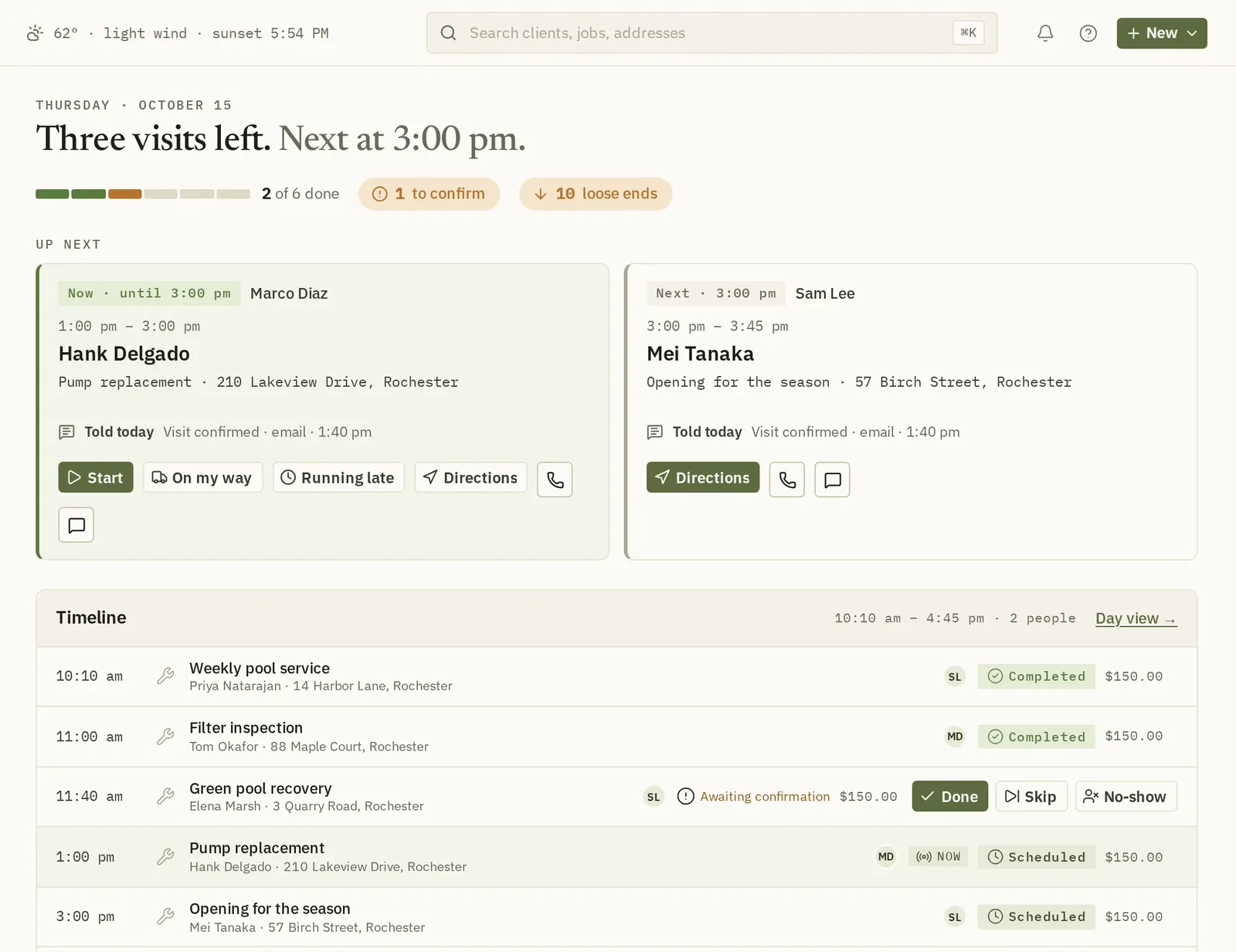
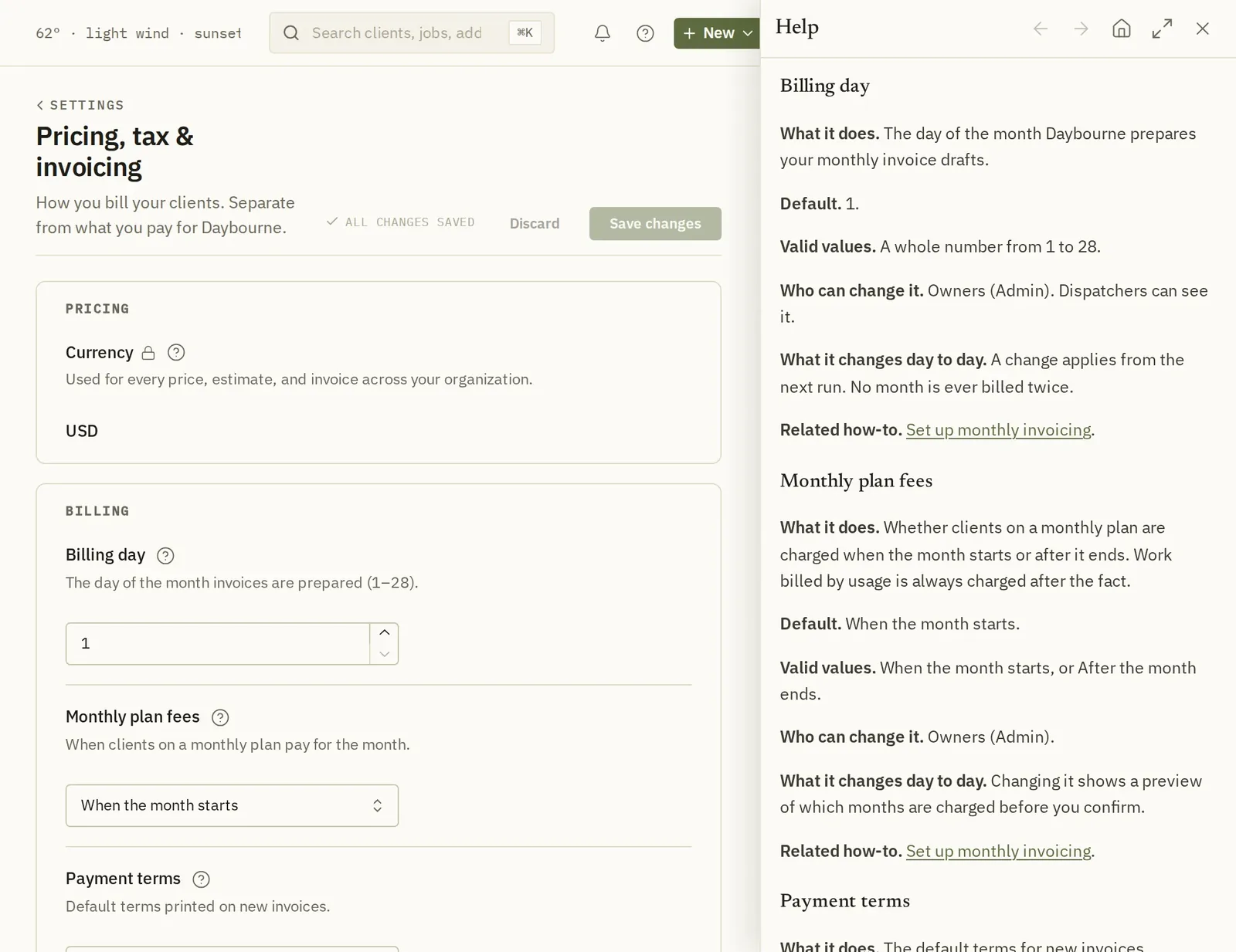
The help center is part of that definition of done. Every screen has a guide that opens beside the work, and there are 81 articles today. The screenshots and short clips in those guides are captured by a Playwright suite that signs in to a seeded demo business at a fixed date and time, so a recapture produces the same picture every time.
Every image and clip of the app on this site came from that suite. I cropped them and did not stage anything by hand.
What comes next
The next milestone is a small, free beta for pool service owners and music teachers, who will request access to join. Before that, I need to finish the QuickBooks Online sync, form the business, publish the terms and privacy pages, and put the app online.